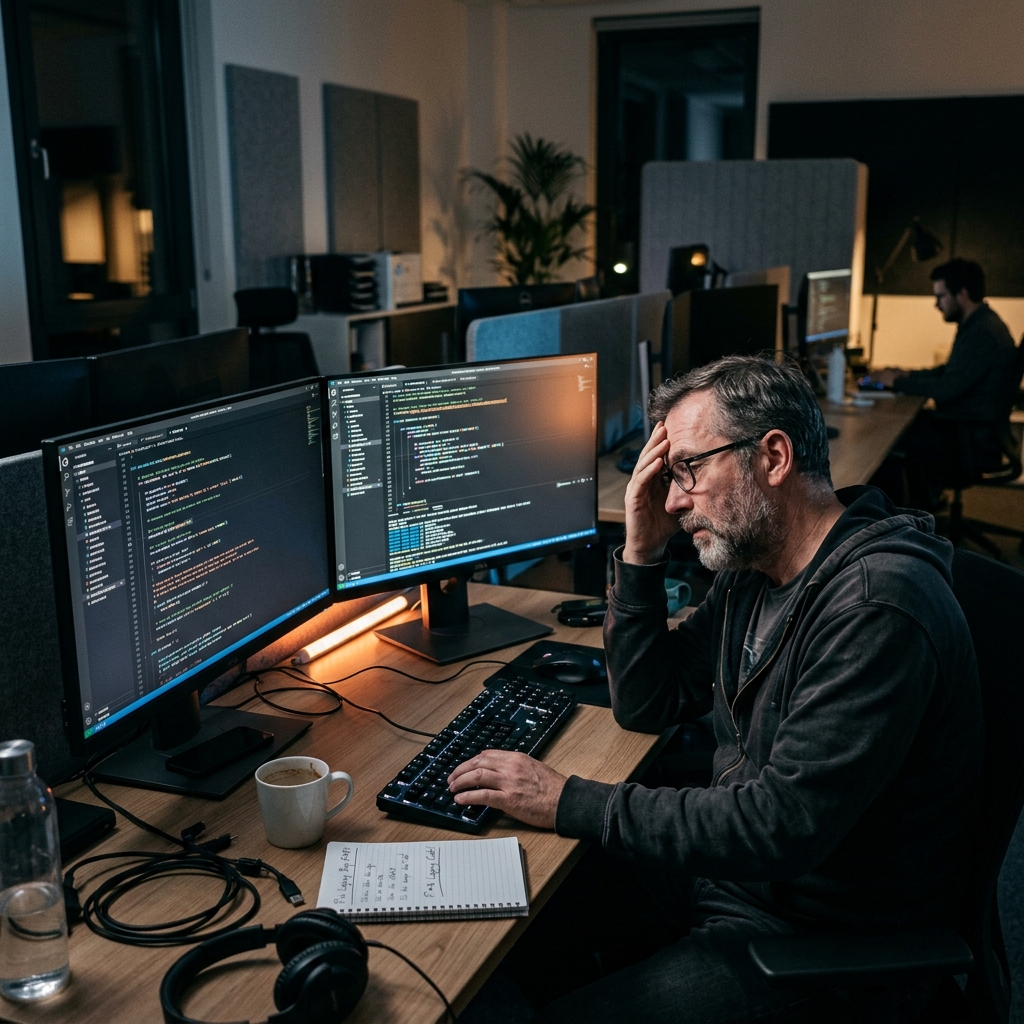

There is a massive debate raging across Hacker News and Reddit right now about the future of software development in 2026. The hype cycle of "vibecoding"—the idea that anyone can just talk to an AI and instantly deploy a billion-dollar startup—has crashed into the messy reality of production systems.
Instead of software engineering getting easier, it has actually become exponentially harder. We have traded the slow, deliberate process of typing code for the frantic, high-stress job of managing "Sloppy-Pasta."
1. The "Sloppy-Pasta" Problem
When you use an AI coding assistant, it optimizes for the fastest path to a passing test or a working UI. It does not optimize for long-term maintainability, database normalization, or zero-downtime deployments. As a result, codebases are ballooning in size.
I frequently consult for startups whose entire backends were written by junior engineers accepting every AI suggestion. The resulting architecture is a nightmare. Functions are 500 lines long, state is managed inconsistently across components, and security vulnerabilities (like SQL injection or unsanitized API inputs) are hidden beneath layers of syntactically perfect TypeScript.
2. The New Bottleneck: Verification over Implementation
For the last decade, the bottleneck in software engineering was implementation. Typing out the logic, scaffolding the API, and writing the tests took time. Today, implementation takes seconds.
The new bottleneck is verification.
If you can generate 1,000 lines of code in 3 seconds, who is going to read it? Who ensures it aligns with the business requirements? Who verifies that it doesn't introduce a memory leak or a race condition?
The job of a software engineer in 2026 is no longer writing code. It is reading, reviewing, and orchestrating code. We have all become senior architects and code reviewers by default.
3. "If You Can't Write It, You Can't Review It"
There is a dangerous trend of developers accepting AI code they fundamentally don't understand. If a developer doesn't understand how the Node.js event loop works, they won't catch the AI when it suggests a synchronous, blocking operation inside a high-traffic microservice.
This is why fundamental computer science knowledge—data structures, system design, database indexing, and network protocols—is actually more valuable today than it was five years ago. You cannot review and secure a system if you don't understand the underlying physics of how it operates.
4. Building is Cheap, Attention is Expensive
The cost to build a Minimum Viable Product (MVP) has plummeted to near zero. You can spin up a SaaS in a weekend. But this has completely saturated the market. When building is cheap, distribution and attention become the most expensive commodities.
The engineering teams that win in 2026 are not the ones who ship the most features. They are the ones who ship the most reliable, performant, and user-friendly features. Sloppy-Pasta architecture will crash your app when you finally get a spike in traffic, destroying the exact attention you worked so hard to capture.
5. How to Survive (and Thrive) as an Engineer
So, will AI replace software engineers? Absolutely not. But it will replace "syntax typers."
To thrive in 2026, you must evolve your skillset:
- Focus on System Architecture: Learn how distributed systems fail. Study Circuit Breakers, Message Queues, and Idempotency.
- Master Database Design: AI is terrible at optimizing database queries and designing normalized schemas for multi-tenant SaaS applications. This is your superpower.
- Prioritize Security and DevOps: Understand how to build secure CI/CD pipelines and configure infrastructure as code.
- Adopt a "Supervisor" Mindset: Treat AI like an extremely fast, enthusiastic intern. It can do the heavy lifting, but you must architect the solution and rigorously review the output.
The future of software development belongs to the architects, the reviewers, and those who can navigate the complexities of production systems. Don't drown in the Sloppy-Pasta.
Frequently Asked Questions
Will AI replace software engineers in 2026?
No, AI will not replace software engineers. However, it will replace developers who only focus on typing code syntax. The role of the software engineer is evolving into a "system architect" who uses AI to generate code, but spends their time reviewing, verifying, and securing the system architecture.
What is "vibecoding" vs true software engineering?
"Vibecoding" is a colloquial term for building software primarily through natural language prompts without deeply understanding the underlying code. True software engineering, on the other hand, involves system design, performance optimization, security, and long-term maintainability.
How is the role of a software developer changing?
The bottleneck has shifted from *implementation* (writing code) to *verification* (reviewing code). Developers in 2026 act more like editors and architects, spending more time debugging, integrating systems, and ensuring code aligns with business logic than writing boilerplate from scratch.
What skills should software engineers focus on for the future?
Engineers should focus on high-level system design, distributed architectures, database optimization, security, and DevOps. Fundamental computer science knowledge is crucial because you cannot effectively review and debug AI-generated code if you don't understand how it works under the hood.
I'm always looking to improve these articles. If you have any feedback, corrections, or just want to discuss software engineering, please reach out to me here.